
Computers can be categorized by their size, purpose, or working principle, including supercomputers, mainframe computers, minicomputers, and microcomputers (like desktops, laptops, and smartphones). Other classifications include servers, workstations, embedded systems, and quantum computers. They can also be classified as digital (handling binary data), analog (processing continuous data), or hybrid (combining both).
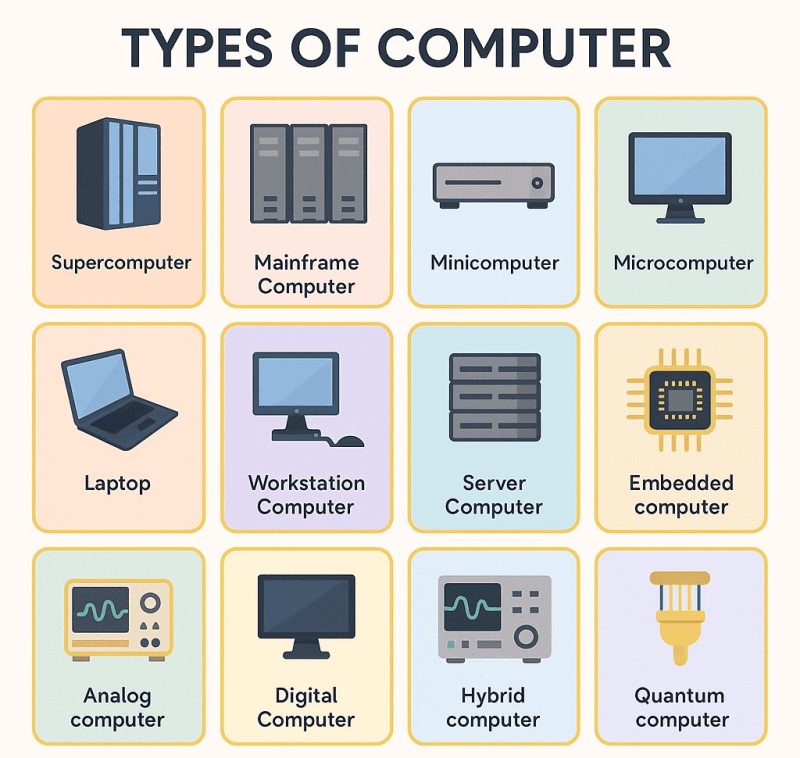
By size and purpose
- Supercomputers: The largest and fastest computers, used for complex scientific and engineering tasks like weather forecasting and nuclear research.
- Mainframe computers: Large, high-performance machines used by major organizations for handling massive amounts of data and supporting thousands of users simultaneously.
- Minicomputers: Medium-sized, multi-user systems that can support a limited number of users, often found in institutions like schools or departments for tasks like billing and accounting.
- Smartphones and Tablets: Handheld, mobile microcomputers.
- Microcomputers: Also known as personal computers, these are designed for individual use and include a wide range of devices.
- Desktops: Stationary personal computers.
- Laptops: Portable versions of desktops.
- Workstations: Powerful microcomputers designed for specific tasks, such as CAD or graphics rendering.
- Servers: Computers designed to provide resources to other computers on a network.
- Embedded systems: Computers built into other devices to perform a specific function (e.g., the computer in a microwave or a car).
- Quantum computers: A newer type of computer that uses quantum mechanics to perform calculations, with potential applications in fields like drug discovery and materials science.
By working principle
- Digital computers: The most common type, these computers operate on discrete data represented by binary numbers (0s and 1s).
- Analog computers: These use continuous physical phenomena to represent data and are used for tasks like scientific modeling where a continuous range of values is needed.
- Hybrid computers: These combine the properties of both analog and digital computers, using both to solve problems.