
A desktop computer is a stationary personal computer designed for a fixed location, typically consisting of a separate tower or case housing the components, a monitor, keyboard, and mouse. It is more powerful than a laptop and offers flexibility for tasks like gaming, graphic design, and content creation, while its stationary nature allows for easier upgrades and better performance. The case can be oriented horizontally or vertically, with a vertical orientation being called a "tower".
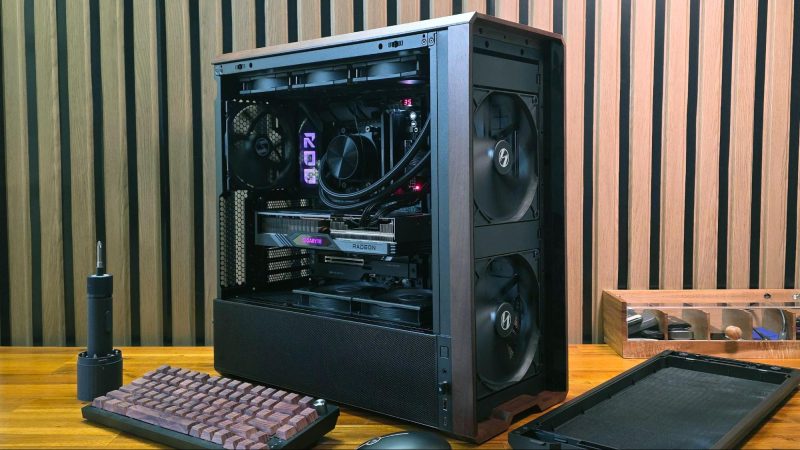
Components
- Case: A housing for the main components, including the power supply, motherboard, and disk storage. It can be placed on, under, or beside a desk.
- Motherboard: The central printed circuit board containing the microprocessor (CPU), memory, and other electronic components.
- Disk storage: One or more hard disk drives (HDDs), solid-state drives (SSDs), or optical disc drives for storing data.
- Input devices: A keyboard and mouse for user input.
- Output devices: A monitor for visual output, and often speakers and a printer for audio and hard copy output.
Key Features
- Stationary design: Unlike laptops, desktops are not portable and are meant for use at a single, fixed location.
- Power and performance: Desktops generally offer more power, can be upgraded more easily, and are better suited for intensive computing tasks than laptops or tablets.
- Flexibility and upgradability: The separate components allow for more customization and easier upgrades compared to an all-in-one laptop.
- Tower vs. traditional desktop: The term "tower" refers to a desktop with a vertically oriented case. In the past, the term "desktop" referred to horizontal cases, but now it can be used to refer to either orientation.